The Autonomy Bottleneck

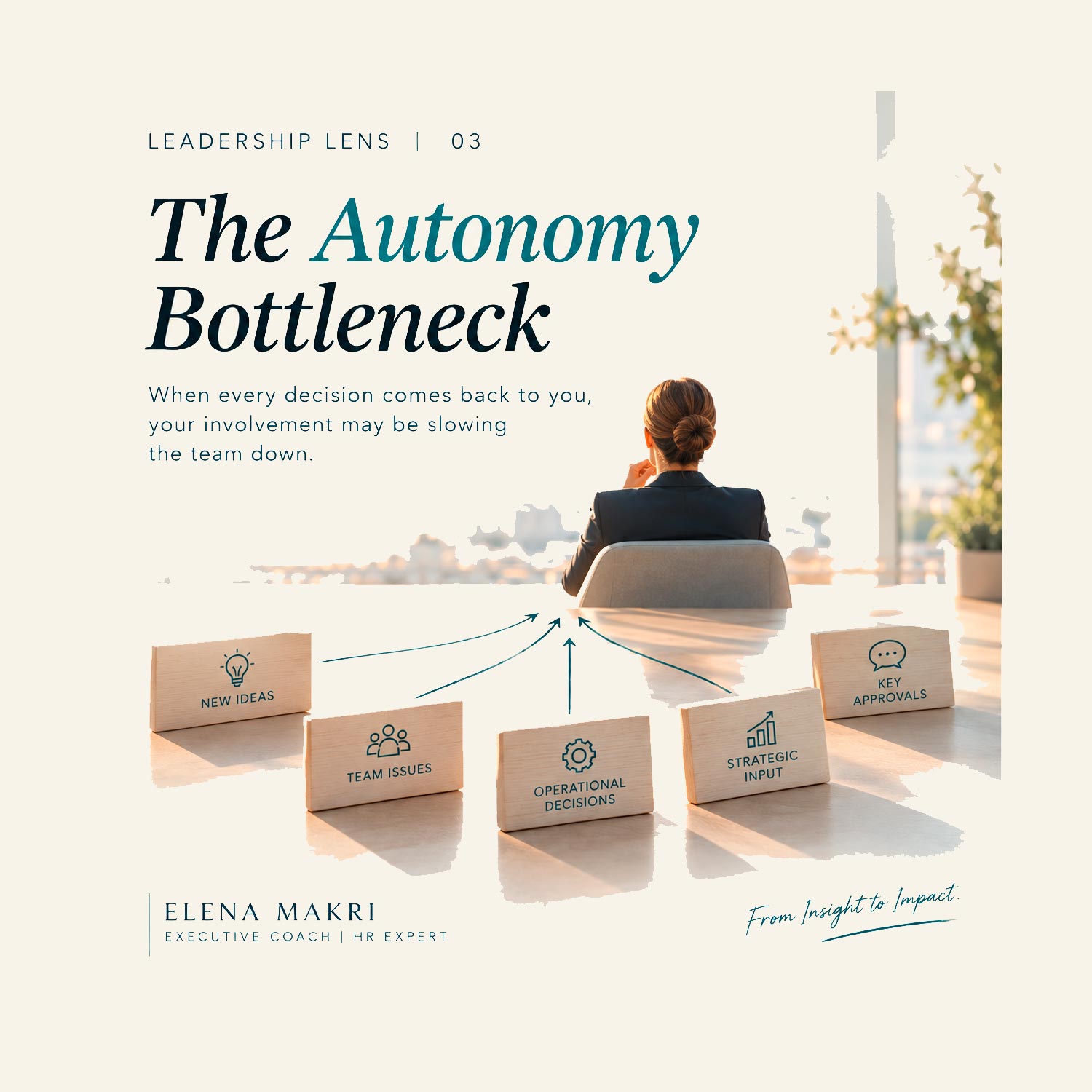
A leader can be deeply involved in every decision and still be limiting the team’s effectiveness.
It often starts with good intentions. A quick review before something goes out. One more approval to make sure the quality is right. A decision brought back to the leader because “it’s safer to check”.

Individually, these may seem reasonable. But when the pattern becomes routine, something shifts. Decisions slow down. People stop exercising their judgement. The leader’s calendar fills with choices that others could have made, and the team becomes increasingly dependent on one person.

The problem may not be a lack of talent. It may be that responsibility has been delegated, but decision-making authority has not. Real delegation is more than assigning tasks. It requires clarity about the outcome, the boundaries, the risks that need escalation, and the decisions people can make without asking first. This is not about stepping away from accountability but about being deliberate about where your involvement adds value, and where it unintentionally creates a bottleneck.

A useful question for any leader:
Which decisions genuinely need you and which ones have simply become used to coming to you?
Nobody Reads the Wall

Nobody Reads the Wall

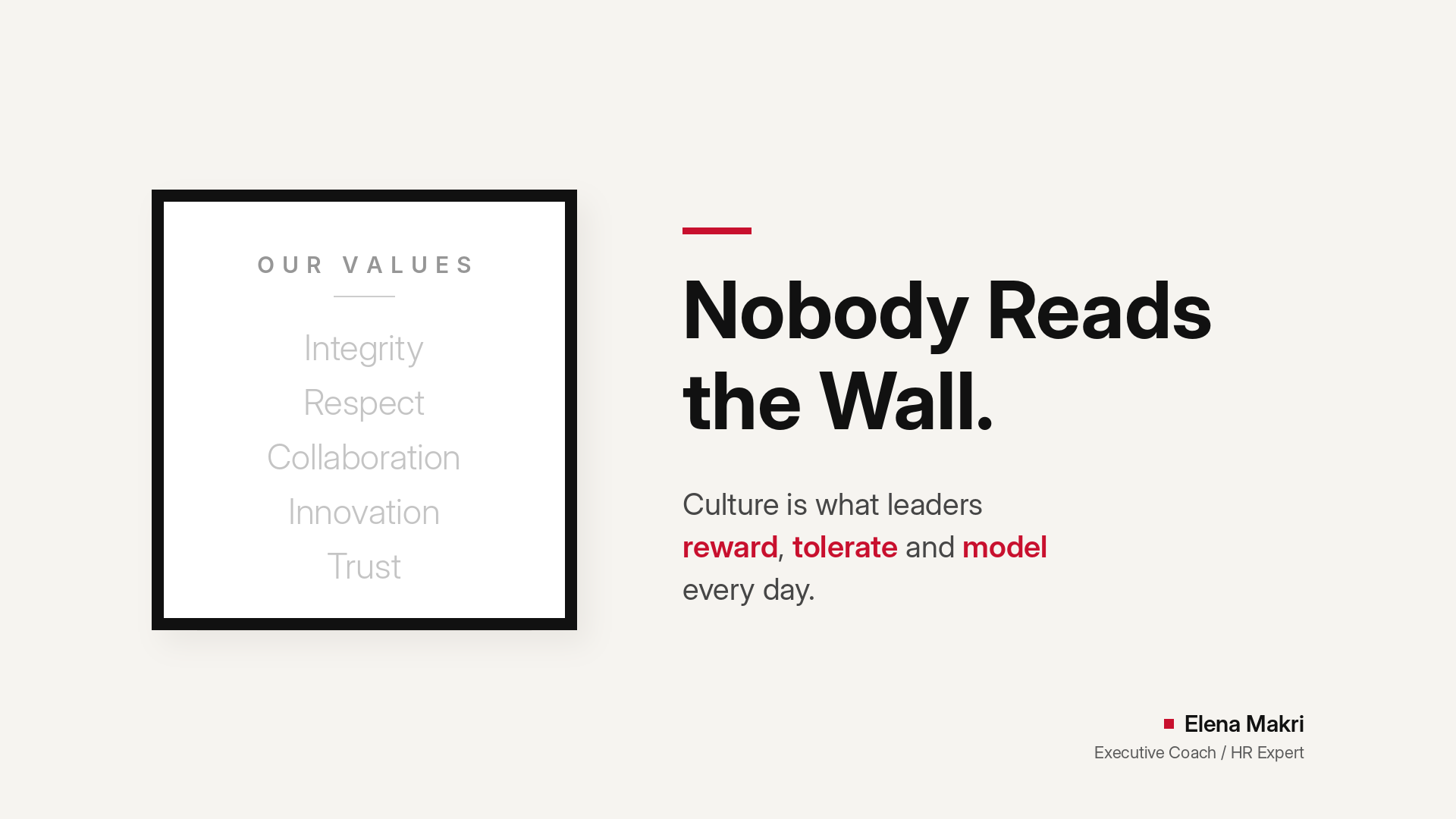
Walk into almost any company and you will find them somewhere: on the reception wall, in the onboarding deck, printed on a mug in the kitchen. Integrity. Respect. Collaboration. Innovation. Carefully chosen words, often debated for weeks by a leadership team at an offsite.

And yet, if you want to understand the real culture of that organization, the wall is the last place to look.

Watch what happens on a Tuesday morning instead.

People learn culture the way we all learned the rules at home as children: not by listening to what was said, but by watching what happened next. Who got praised. Who got away with it. What made the room go quiet. Coming from a background in CBT Psychology and Evidence-based Coaching, I see this as one of the most underestimated truths in organizational life: values statements describe simply intentions. What people experience shapes what they believe. And what they believe drives how they behave.

Three verbs carry most of that teaching.

What leaders reward

Every reward is a message, and people read it far more carefully than any memo. When the person promoted this year is the one who hit every target while leaving a trail of exhausted colleagues behind, the organization has just explained what “Respect” really means here, without a single word.

Rewards are not only bonuses and promotions. They are also who gets airtime in the meeting, whose idea is picked up, who receives the thank-you email with the CEO in copy. Small signals, repeated, become the operating system.

What leaders tolerate

This is the quietest of the three, and often the most powerful.

I knew of an organization that kept a senior leader whose behavior was an open secret. Public outbursts. Intimidation as a management style. Colleagues and team members on the receiving end, again and again. Everyone at the top was aware. Nothing changed. The explanation was never written down, but it didn’t need to be: the numbers were good.

That one decision taught the organization more than any training program could. It said that results buy immunity. It said that speaking up is pointless. And it showed every manager watching exactly how far they could go.

When nothing happens, something still happens. Tolerance is a decision, even when it feels like the absence of one. Silence from a leader is never neutral. It is simply unsigned.

The revenue argument also rarely survives a closer look. The cost is still paid, in turnover, disengagement and lost talent. It simply appears in other lines of the budget, where nobody connects it to its source.

What leaders model

Then there is the mirror. Teams copy what leaders do under pressure, not what they recommend in calm moments. A leader who talks about wellbeing and sends emails at 11 p.m. has, in effect, published a new policy. A leader who asks for openness but reacts defensively to bad news teaches people to bring only good news. That is how organizations end up surprised by problems everyone below them already saw.

Modeling is uncomfortable because it removes the distance between the leader and the culture. There is no “they” to blame. To a large extent, the culture reflects our own daily choices, multiplied.

Why this is good news

It would be easy to read all this as a warning. I see it as an invitation. If culture lived only on walls, changing it would mean new slogans and another rebranding exercise. Because it lives in everyday behavior, it can shift through everyday behavior: starting this week, and without a budget.

From a cognitive-behavioral perspective, this is exactly how change works for individuals. Grand declarations rarely do it. Small, consistent actions slowly rewrite what feels “normal.” Organizations are no different. They are simply many people learning at the same time.

A simple Friday afternoon audit

Before closing the laptop this Friday, any leader can ask three questions:

  1. What did I reward this week, openly or quietly?
  2. What did I let pass that I would not want repeated?
  3. What did I do that I would be happy to see my team copy?

The answers will say more about your culture than any engagement survey, and much more than the wall.

The values on the wall are a promise. Leaders are the evidence.

The Meeting After The Meeting

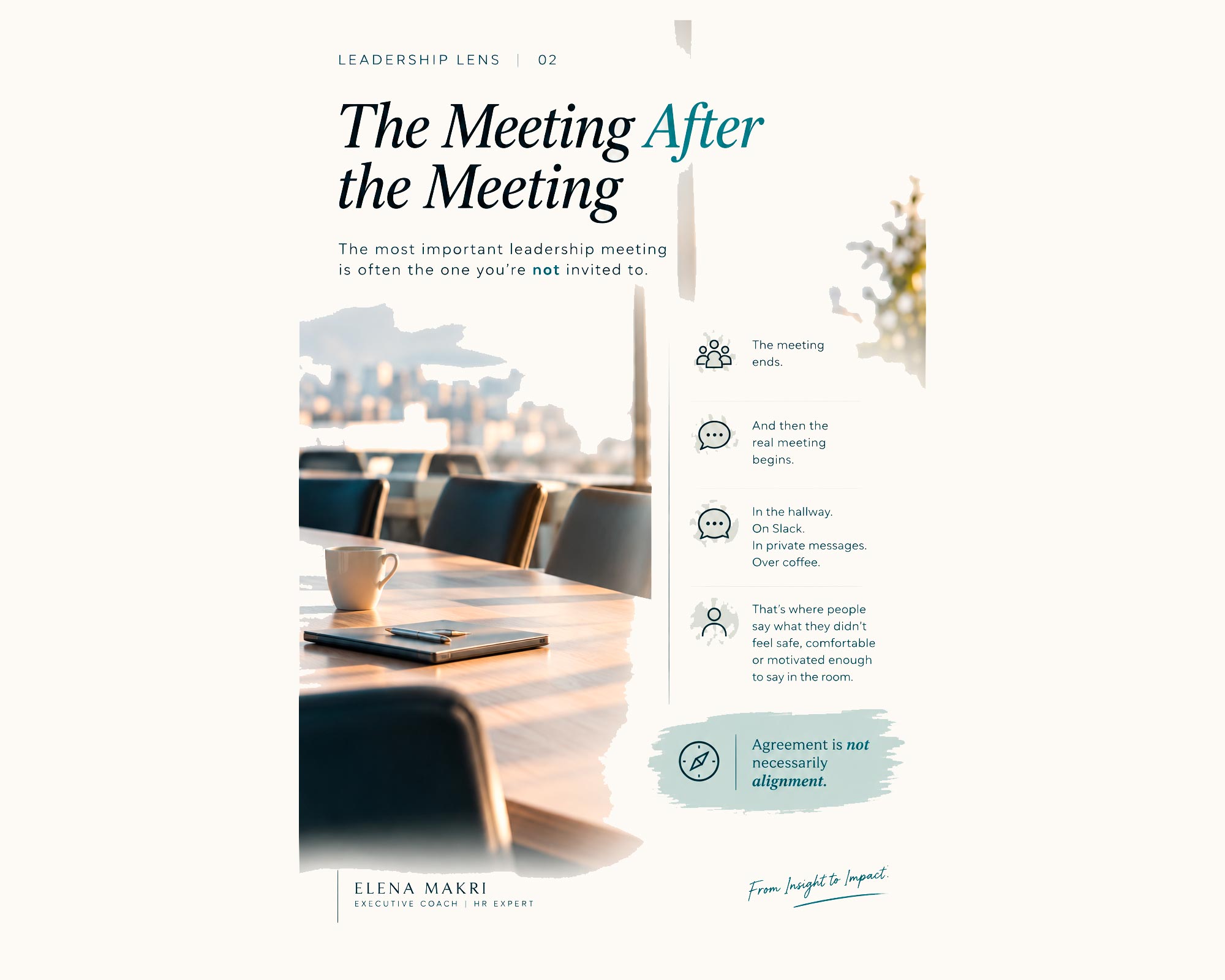
The most important leadership meeting is often the one you’re not invited to.

The meeting ends.

Everyone nods. The decision is made. People leave the room. And then something interesting happens.

The conversation continues.

In the hallway. On Slack. In private messages. Over coffee.

That’s often where people say what they didn’t say in the room. Not necessarily because they are difficult or resistant. Sometimes because the room didn’t feel safe enough for disagreement. Sometimes because the decision had already been made. Sometimes because saying “I disagree” to the leader feels more costly than simply saying “I agree” and figuring things out later.

And this creates one of the most expensive illusions in leadership:

Agreement ≠ Alignment.

The 10% Threshold

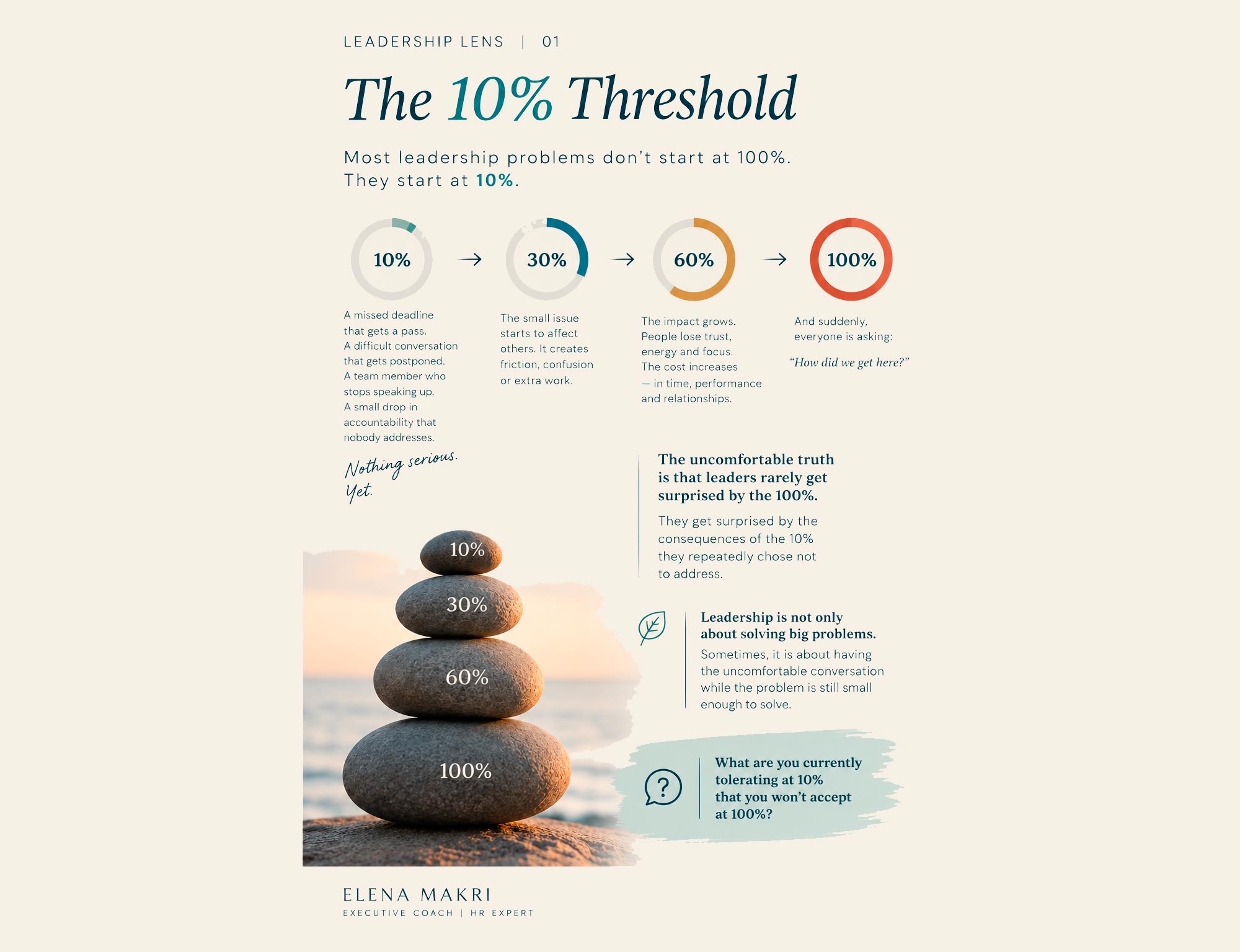
Most leadership problems don’t start at 100%.

They start at 10%.

A missed deadline that gets a pass. A difficult conversation that gets postponed. A team member who stops speaking up. A small drop in accountability that nobody addresses.

Nothing serious. Yet.

So we move on.

Until 10% becomes 30%.
30% becomes 60%.

The impact grows. Trust erodes. Friction increases. And what once needed a simple conversation now requires a much bigger intervention.

And suddenly, everyone is asking:

“How did we get here?”

The uncomfortable truth is that leaders are rarely surprised by the 100%. They are surprised by the consequences of the 10% they repeatedly chose not to address. Leadership is not only about solving big problems. Sometimes, it is about having the uncomfortable conversation while the problem is still small enough to solve.

What are you currently tolerating at 10% that you won’t accept at 100%?